
Pelham, NH Historical Society
Pulpit Rock
A Place Where Pelham’s History Began
Long before Pelham became a town of its own, travelers were passing through the land that would eventually become our community. One of the most intriguing reminders of those early days is Pulpit Rock, a natural granite outcropping associated with the earliest European settlement in Pelham.
According to local tradition, in April 1719, a group of Scottish-Irish settlers traveling through the area stopped to observe the Sabbath. Their minister, the Reverend James McGregor, is traditionally said to have preached from this natural rock formation.
Today, Pulpit Rock is recognized as the site of what local history identifies as the first sermon preached in what is now Pelham, New Hampshire.


The Journey to Nutfield
The story of Pulpit Rock begins with a group of Scottish-Irish settlers who had emigrated from Ulster, Ireland, in 1718 under the leadership of Reverend James McGregor. After a difficult first winter in Maine, members of the group traveled through Massachusetts in search of a suitable place to establish a permanent settlement.
In the spring of 1719, some of the settlers traveled north from the Dracut and Haverhill area toward land that would eventually become known as Nutfield. That settlement later developed into the communities of Derry, Londonderry, and Windham, as well as portions of several surrounding towns.
Their route took them through the wilderness of what is now southern New Hampshire.
It was during this journey, according to Pelham tradition, that the travelers stopped at the rock now known as Pulpit Rock to keep the Sabbath.
Reverend James McGregor
Reverend James McGregor was a Presbyterian minister who had emigrated from County Londonderry, Ireland, with members of his congregation. He became an important religious and community leader among the settlers who established Nutfield.
The settlers' journey eventually led them to the land that became Londonderry. McGregor is remembered as the first minister of the Londonderry settlement and as an important figure in the establishment of the early Presbyterian community in New Hampshire.
The connection between McGregor and Pulpit Rock is an important part of Pelham's early history, because it places the town within the story of the larger Scottish-Irish migration that shaped much of southern New Hampshire.
Why Is It Called Pulpit Rock?
An early account of the large, weathered granite formation described the rock as having the appearance of a natural pulpit and suggested that it was easy to imagine an early preacher standing there to address his congregation.
Whether Reverend McGregor actually stood on the rock itself, or whether the location became associated with the sermon through generations of local tradition, the name Pulpit Rock has remained part of Pelham's historical landscape.


The 1932 Memorial Plaque
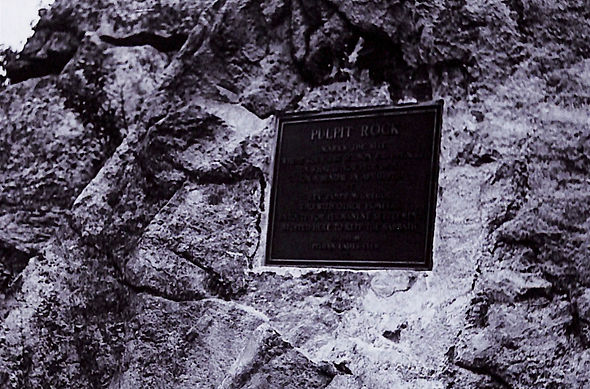
For many years, the story of Pulpit Rock was passed down as part of Pelham's local history. In 1932, the Pelham Ladies Club placed a bronze plaque on the rock commemorating the event.
The plaque identifies Pulpit Rock as:
“The site where the first sermon was preached in what is now Pelham, N.H. on a Sunday in April 1719 by Rev. James McGregor.”
It explains that McGregor and other pioneers, while traveling toward a permanent settlement, stopped at the location to observe the Sabbath.
The plaque remains an important physical reminder of one of the earliest stories associated with Pelham.
The 1932 Plaque Dedication Speech & Poem
We are gathered here this evening to commemorate a service held — so tradition tells us — in this exact spot over two centuries ago. In fact over two hundred and thirteen years have elapsed since that hardy and adventurous band of our pioneer forefathers arrived here one Saturday night on their way to permanent settlement in old Nutfield now Derry, and parts of Londonderry and Windham.
As was the custom in those early days the Sabbath Day was kept inviolate. Therefore these pioneers sought refuge here for the night that they might keep that Day holy in every aspect of the word.
As we stand here tonight in thoughtful reverie, how easy it is to reconstruct, in a way, a picture of that early pilgrimage.
For instance, those pioneers had journeyed “up river” from Haverhill and were then taking this cross-country trail when Saturday night overtook them.
They were traveling this old Indian trail through a wilderness known as Draw-cutt, which led from the Indian Reservation at the Great Bunt below Pawtucket Falls on the Merrimack and which extended northward through this wilderness to Corbett’s Pond in Windham, originally known as Draw Pond, and also still farther beyond.
However, the pioneers had reached this spot and the leaders decided to camp.
Just imagine a growth here of primeval pine forest untouched by man and imagine the seclusion and safety that such a place as this afforded.
Think of the protection of these rugged ledges, all offering a welcome refuge from weather or from foe of any kind and an opportunity for rest, and above all things fulfilling a heartfelt desire by furnishing an ideal spot wherein they could worship unmolested as they kept the Sabbath.
We can readily appreciate the genuine relief and thankfulness that these pioneers must have felt for the seclusion and safety afforded on their arrival here on that Saturday night.
And so here they pitched their tents, so to speak, and in the glorious morning of the following day a sermon was preached and here we would mark the spot.
“Old Pulpit Rock” — A monument in itself — known for generations and generations as the place where the first sermon was preached in what is now Pelham. A spot worthy of commemoration and respect, hallowed in the name of the Maker by a minister of the Gospel centuries ago.
Pulpit Rock
It is the Sabbath morn,
The day of all the best,
A band of pilgrims here have stayed
To worship God and rest.
No canopy spread o’er their heads
Save the blue vault of heaven,
While from the Book the pastor read
Of the Saviour for sinners given.
Would we could lift the veil of years
And gaze upon the scene,
We know not what hopes and fears
It would to us reveal.
Though many years have passed since then
The place a grandeur wears
Which through eternity shall last
And all that its impress bears.
We’d call it holy ground
The spot where first they trod,
’Twas here they stood and sang
Their hymns of praise to God.
Otis Woodbury
Pelham, New Hampshire
A Story Older Than the Town
One of the most fascinating things about Pulpit Rock is that the story dates to 1719, 27 years before Pelham received its formal charter in 1746.
The Town of Pelham's historic-resource documents acknowledge the 1719 Pulpit Rock tradition while noting that European settlement in Pelham itself began later.
This makes Pulpit Rock more than just an interesting roadside landmark. It represents a time when the area that we now call Pelham was still wilderness and when travelers, explorers, and settlers were moving through the Merrimack Valley in search of places to establish new communities.
Tradition and History
Like many stories handed down through local history, the story of Pulpit Rock deserves a little context.
The 1719 sermon is preserved in Pelham's local tradition, and the 1932 historical marker commemorates it. The Town of Pelham also recognizes Pulpit Rock as a historic site associated with the 1719 event.
At the same time, historians have documented Reverend McGregor's journey and his role in the settlement of Nutfield. Historical accounts also document his preaching in the Nutfield settlement shortly afterward.
For that reason, Pulpit Rock is best understood as both a historic place and a cherished piece of Pelham tradition.
A Small Rock with a Big Story
Today, Pulpit Rock can be easy to overlook. It does not look like a grand monument or historic building. It is simply a weathered piece of granite beside the road and the grasses in front of it grow tall in the summer months, often blocking its view.
But that ordinary-looking rock connects Pelham to the earliest years of European settlement in southern New Hampshire.
More than three centuries ago, travelers stopped here, paused their journey, and observed the Sabbath. Generations later, Pelham residents recognized the significance of the location and placed a plaque there so that the story would not be forgotten.
Pulpit Rock is a reminder that Pelham's history did not begin with the town charter in 1746. The story of this place reaches back decades earlier—to the trails, travelers, settlers, and communities that came before the town we know today.
