
Pelham, NH Historical Society
A Summer Resort Town
In the late 1800s and early 1900s, Pelham contained over 17,000 acres of land and fewer than 1,000 residents. Its roads were narrow and unpaved, used by horse-drawn carriages and wagons. Pelham was primarily an agricultural community, blessed with an abundance of large prospering farms which provided great quantities of dairy products and fresh vegetables to neighboring mill cities of Haverhill, Lawrence, Lowell and Nashua.
In addition to its impressive farms, Pelham has four sparkling, clear ponds - Long Pond, Gumpas Pond, Little Island Pond, and White's Pond (Now Harris' Pond). It also has two lengthy fish-filled brooks - Beaver Brook and Golden Brook - and numerous trout streams. The highest observation tower within 30 miles sat on top of Jeremy Hill.
The green, well manicured farms of Pelham provided a sharp contrast to the congested streets, polluted rivers and sweltering company-owned tenements of the neighboring mill cities. Seeking temporary relief from these conditions, many city dwellers began to spend their summers in Pelham.
They enjoyed hiking, swimming, fishing, horseback riding, boating, canoeing, shuffleboard, tennis, peace and quiet. To the city children, even helping with farm chores was a form of recreation.
Many large homes, once filled with as many as a dozen children, were converted to summer boarding houses. Summer cottages were built on Long Pond, Gumpus Pond, and Little Island Pond.


In 1906, the Harris Family opened Grand View House on the southerly side of North Pond, later known as North Lake, White's Pond, and eventually Harris Pond. It was a four story inn with dozens of guest rooms, maid service, and a large, full service dining room.
A 1909 advertisement for Grand View House from the Old Home Day Souveneir book.

On the east end of North Lake sat the Pleasant View House, a boarding house operated by the Russ Family. It had its own beach, which remained open to the public long after Pleasant View House stopped receiving guests.


Opposite Grand View House, Henry Kingman Webster built a summer residence in a large pine grove, Mr. Webster was the founder of H.K. Webster Company, which remains a prospering agricultural feed company, selling under the Blue Seal label. He lined both sides of the street with expensive high granite walls; the raw materials came from several quarries on Gage Hill.
H.K. Webster was known as "King Webster" in the business community of Lawrence. His biographer wrote about "King's" summer home as follows:
The Webster House on Webster Avenue
"One of the delights of Henry Kingman Webster was to drive out of the City and enjoy the quiet of the natural countryside. In May of 1888 he purchased a tract of land on the shore of White's Pond, in Pelham, New Hampshire, just a convenient carriage ride from Lawrence. In 1889 he built the comfortable summer home there which still stands on the east shore of the pond in the midst of a beautiful pine grove. Here he spent his summers until 1912."
Not far from White's Pond, at the location of the present day New England Pentecostal Church, Walnut Shade Inn was built and for many years was operated by Evelyn and Tom Devlin.
In later years, it was called Hilltop House.
It had rooms for boarders, function rooms, separate cabins and extensive outdoor recreational facilities.


To accommodate Pelham's summer guests and to further promote the Town of Pelham, Harry H. Atwood, the proprietor of Atwood's General Store in Pelham Center, hired photographers and produced penny postcards displaying Pelham's historic buildings and beautiful natural features. Many cherished memories of summer vacations in Pelham were recorded on Harry Atwood's postcards.
Between 1925 and 1950, Pelham's role as summer resort slowly came to an end. The advent of the automobile made it possible for the residents of Haverhill, Lawrence, Lowell and Nashua to travel much further than Pelham to find summer accommodations.

However, Pelham's resort status began to wane among the citizens of the surrounding mill towns, and many charitable organizations began to recognize Pelham's potential for summer recreation.
In 1926, the Lowell Rotary Club, with financial assistance from the Paint and Powder Club, purchased a large twelve-room home on Marsh Road, which had been built by Enoch M. Marsh in 1856.
The Rotary Club used the home and the adjacent twenty-three acres as a children's health camp for many years.
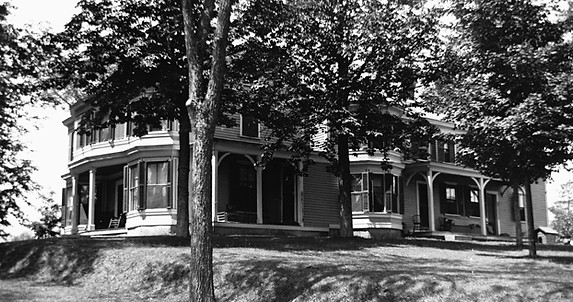
The Marsh House became the Fresh Air Camp for the disadvantaged youth of Lowell in 1926
In the early 1930s, the Greater Lowell Girl Scout Council purchased more than 200 acres of the old Frye Gage Farm on the west side of Little Island Pond. The Girl Scouts have operated Camp Runels at this location for more than ninety years.


In the 1940s, the Lowell YMCA purchased 56 acres of land with 800 feet of frontage on Long Pond. This property, known as Camp Alexander, served as a YMCA day camp for many years until it was purchased by the Town of Pelham. It is now known as Veteran's Memorial Park.
Almost directly across Long Pond from Camp Alexander, the Lowell Catholic Charities established St. Mary's in the Pines, another day camp for the children of Lowell.
In the 1950s, with financial aid form the Nashua Kiwanis Club, the Nashua Girl Scout Council purchased about eighty acres of the old Sherburne Farm on the west shore of Long Pond. Camp Kiwanis was established on the site as Girl Scout camp and it operated for many years.
Pelham's role as a summer resort has come to an end. The boarding houses have all closed. Harris' Inn, was closed to overnight guests, but remained one of the finest function facilities in the area up through the year 2020, and now has permanently closed down as a function hall. All of the youth camps have closed, except for Camp Runels. Each year, a lucky few hundred Girl Scouts return to Camp Runels to experience what thousands of people before them had experienced - a wonderful summer vacation in Pelham.
Gallery: Pelham Summer Resorts & Lakes


Coffee Lots
This ad was placed in the Lawrence Evening Tribune on January 3, 1929. The advertisement offered a free camp or house lot on Little Island Pond to every person who purchased three pounds of Monarch Coffee. (Not over 2 lots to a customer.) Many lots were sold as a result of this advertising gimmick, and to this day the term "Coffee Lot" is often used to describe certain parcels of land on the pond.
In the years since, many of these coffee lots were purchased by the town as conservation land.
